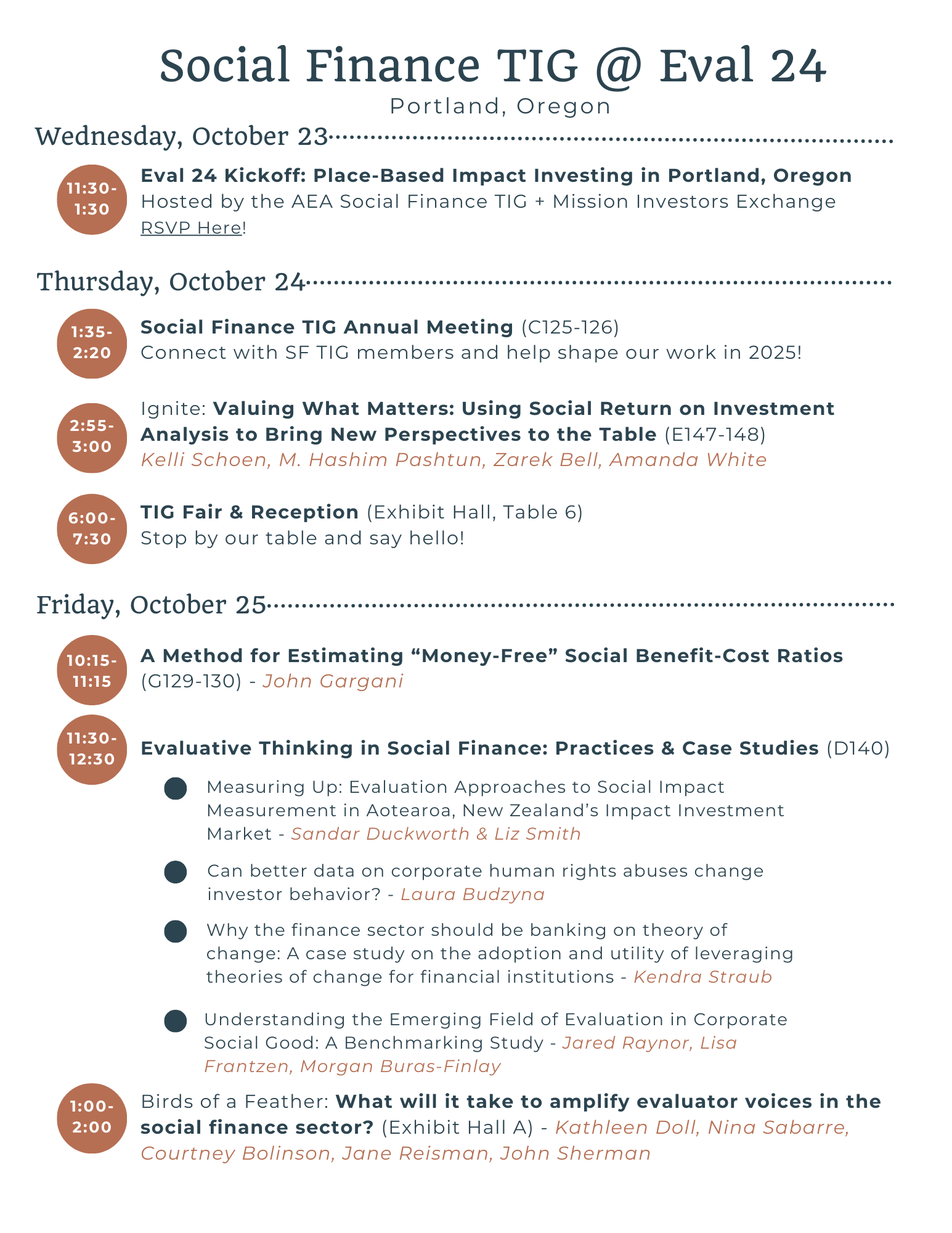
Will we see you in Portland? The Social Finance TIG is sponsoring the following events at Eval 24 in Portland, Oregon in October 2024:
Eval 24 Kickoff: Place-Based Impact Investing in Portland, Oregon
Hosted by the Social Finance TIG and Mission Investors Exchange
Wednesday, October 23
11:30 AM-1:30 PM
RSVP here!
Social Finance TIG Annual Meeting
Thursday, October 24
1:35-2:20 PM
C125-126
Connect with Social Finance TIG members and help shape our work in 2025! All are welcome.
Valuing What Matters: Using Social Return on Investment Analysis to Bring New Perspectives to the Table (Ignite)
Kelli Schoen, M. Hashim Pashtun, Zarek Bell, Amanda White
Thursday, October 24
2:55-3:00 PM (Ignite Session 2, 2:30-3:30)
E147-148
Social return on investment (SROI) analysis is premised on the idea that meaningful program outcomes are best identified by those who experience them. Two of the underlying principles of SROI in particular–-Involve Stakeholders and Value What Matters—explicitly center the perspectives of those who are most affected by a program or activity. In doing so, SROI shifts power away from traditional notions about whose experiences matter and which outcomes should be measured and managed. Since incorporating SROI into our organization’s analytical toolkit, we have been pushed to include a broader array of voices and experiences in the stories of change that we tell. A recent SROI analysis of a rental assistance program, for example, included not just the traditional focus on eviction prevention, but also an account of the mental health impacts experienced by caseworkers administering the program, and a measure of the improved quality of parent-child interaction among program beneficiaries. Another SROI analysis of a small agricultural enterprise unexpectedly led us to contemplate not just the financial impact of the organization’s activities, but also the effect of certain agricultural practices on bovine wellbeing. In addition to keeping us on our toes, this incorporation of SROI into our work has allowed us to place the outcomes that are important to stakeholders on equal footing with other more traditional outcomes, even when stakeholder priorities are not associated with a fixed market value. This session will begin with an explanation of SROI's approach to stakeholder involvement and its emphasis on understanding stakeholder priorities. Then, using examples from several recently completed SROI analyses, we will discuss the ways that SROI can bring the voices of previously underrepresented stakeholders into discussions about a program’s value. Participants will leave the session with a clear understanding of the processes of stakeholder identification, stakeholder-led outcomes articulation, and key principles underlying SROI.
TIG Fair and Reception
Thursday, October 24
6:00-7:30 PM
Exhibit Hall, Table 6
Stop by our table and say hello!
A Method for Estimating "Money-Free" Social Benefit-Cost Ratios
John Gargani
Friday, October 25
10:15-11:15 AM
G129-130
I introduce “parity-adjusted returns”, a type of social benefit-cost ratio that can be estimated without monetizing benefits or costs. Many social investors and philanthropic funders depend on social benefit-cost ratios when making resource-allocation decisions for the public good. Because they allocate monetary resources, investors and funders must contend with the considerable challenge of “monetizing” (attaching monetary value to) benefits and harm that are not monetary in nature. It may be possible to avoid monetization altogether by applying a recent idea from philosophy called parity. I use the fundamental impact value equation (FIVE), which I introduced at last year’s AEA conference, to demonstrate how. The method I describe may be controversial, and I encourage feedback from participants. I also provide access to a draft paper that outlines the underlying concepts and includes worked examples.
Evaluative Thinking in Social Finance: Practices and Case Studies
Friday, October 25
11:30-12:30 PM
D140
Measuring Up: Evaluation Approaches to Social Impact Measurement in Aotearoa New Zealand's Impact Investment Market
Sandar Duckworth & Liz Smith
The measurement landscape in Aotearoa, New Zealand's impact investment market. The rhetoric on impact investing in New Zealand is strengthening. Impact investment focuses on generating both financial returns and positive social or environmental outcomes. These initiatives reflect a growing global trend of impact investing, where investments align with the values of investors who seek to contribute positively to society and the environment. The environment in Aotearoa, New Zealand is unique in the impact investing space because of the rich perspective of Te Ao Māori (Māori worldview), Pasifika and diverse communities. The Māori economy is experiencing growth, with the asset base expanding faster than the overall economy.
Impact investment can have a significant benefit for diverse communities. Impact leaders want to know their investments are delivering the intended social and environmental impacts. The importance of impact measurement has never been greater. Evaluating social impact investments involves a range of evaluation theories and methods. However, as the work of the AEA TIG Social Finance highlights little is known about how impact investors apply evaluation theories and methods. We are sharing the insights from landscape study on how evaluation theories and methods are used by impact investors in Aotearoa, New Zealand.
Our session is one of four papers on building and strengthening evaluative thinking within the social finance sector. The sessions are interlinked to showcase the state of practice in social finance in the U.S. and New Zealand and to demonstrate 'real-life' scenarios on what evaluation looks like at an organizational-level.
Can better data on corporate human rights abuses change investor behavior?
Laura Budzyna
If investors had better, more timely data about companies’ human rights performance, what would they do differently? Could their actions and influence ultimately reduce the incidence of human rights abuse?
Increasingly, investors are concerned about the human rights records of companies in their portfolios, but they typically lack the in-depth information needed to inform their decisions to invest, influence or divest. NGOs and researchers produce this data, but it is rarely in a format that is easily integrated into investors’ decision-making processes.
In 2022, with support from Humanity United, a human rights NGO began to develop an application programming interface (API) that would deliver their data to investors in a more systematic, automated, and timely manner. In parallel, the NGO designed an evaluation and learning framework to accompany and guide the technology’s implementation. This session will chronicle the design and evolution of that learning framework over the course of the first nine months of the API’s development.
We will share the design research that uncovered investors’ needs, behaviors and aspirations, the theory of change that describes the technology’s potential impact pathways, and the plans and instruments for outcome measurement. We will also share challenges, lessons and reflections on this work for others engaged with corporate sustainability, ESG investing, technology, and human rights.
Why the finance sector should be banking on theory of change: A case study of the adoption and utility of leveraging theory of changes for financial institutions
Kendra Straub
As financial institutions seek to make an impact and develop products and services to drive positive change for communities, people, and the environment, more focus is placed on what tools can enhance the financial sector's communication, transparency, and accountability toward internal and external stakeholders about that mission. Particular emphasis has been placed on framework development, financial investment and capital deployment tracking, and external commitment progress reporting. However, the gap remains for how financial institutions can test and monitor if the interventions developed towards these missions lead to specific change in communities and target long-term outcomes. This presentation will summarize the powerful story of how the adoption of the theory of changes answered this gap for U.S. Bancorp Impact Finance, unpack how to tailor a theory of change to investigate the financial, social, and environmental returns, and share lessons learned from the first internal Impact Measurement and Management function of U.S. Bank. Often, the theory of change is an evaluation tool validated in the nonprofits, healthcare, education, and government sectors. Thus, the next evolutionary step is the logical application of a theory of change for financial institutions as their mission aligns with community and environmental concerns similar to those of other sectors. U.S. Bancorp Impact Finance has become a success story for how the theory of change can be an additional tool in the toolbox and leveraged for different investment strategies and community commitments. This presentation will map the process that gained the Theory of Change a similar internal credibility as OKRs, initiative development plans, and financial forecasting. This expert lecture will leverage the exemplar of U.S. Bancorp Impact Finance to advocate for financial institutions to expand the application of the theory of change to evaluate intended and unintended impact and call for the learnings in the finance sector to be shared with the evaluation field. The lecture is tailored so impact measurement subject matter experts can learn how evaluation tools are gaining utility in new industries and will create a collaborative space for unpack how Theory of Change gain credibility in new fields.
Understanding the Emerging Field of Evaluation in Corporate Social Good: A Benchmarking Study
Jared Raynor, Lisa Frantzen, Morgan Buras-Finlay
Traditionally, the corporate sector has not been a place for impact measurement, with corporations doing little to assess the value and impact of their philanthropic donations, and with all measurement focusing squarely on financial performance and business effectiveness. This session will present the origins and findings from a new corporate M&E Benchmarking survey. Results will provide insight into how companies approach, staff, and leverage impact measurement & evaluation in their corporate social impact and philanthropy work.
What Will It Take to Amplify Evaluator Voices in the Social Finance Sector? An Emergent Learning Exercise (Birds of a Feather)
Kathleen Doll, Nina Sabarre, Courtney Bolinson, Jane Reisman, John Sherman
Friday, October 25
1:00-2:00 PM
Exhibit Hall A
The social finance ecosystem continues to rapidly expand, with increased dollars flowing and more actors engaging than ever before. Despite the influx of engagement and capital flowing into the social finance scene, measurement of impact from social finance endeavors is difficult for a myriad of reasons.. For one, there continues to be a “culture clash” between the worlds of social change and finance, resulting in a lack of shared understanding about the skills, knowledge, and abilities that are required for impact measurement in the social finance sector. Evaluators have a unique opportunity to be “bridge builders” between these worlds, while also promoting approaches to social impact measurement that are rooted in equity. In this think tank, facilitators will guide attendees through an interactive Emergent Learning Table exercise, seeking to answer the framing question: What will it take to amplify and integrate evaluator's voices into the social finance sector? Attendees will have the opportunity to share their experiences with impact measurement in the social finance sector, collectively generate insights about these shared stories, form new hypotheses, and align on opportunities for action.
To see the sessions sponsored by the Social Finance TIG at Eval 2023 in Indianapolis, click here.